How to Wire a Half-Hot Outlet (Switched Receptacle & Break-Off Tab)
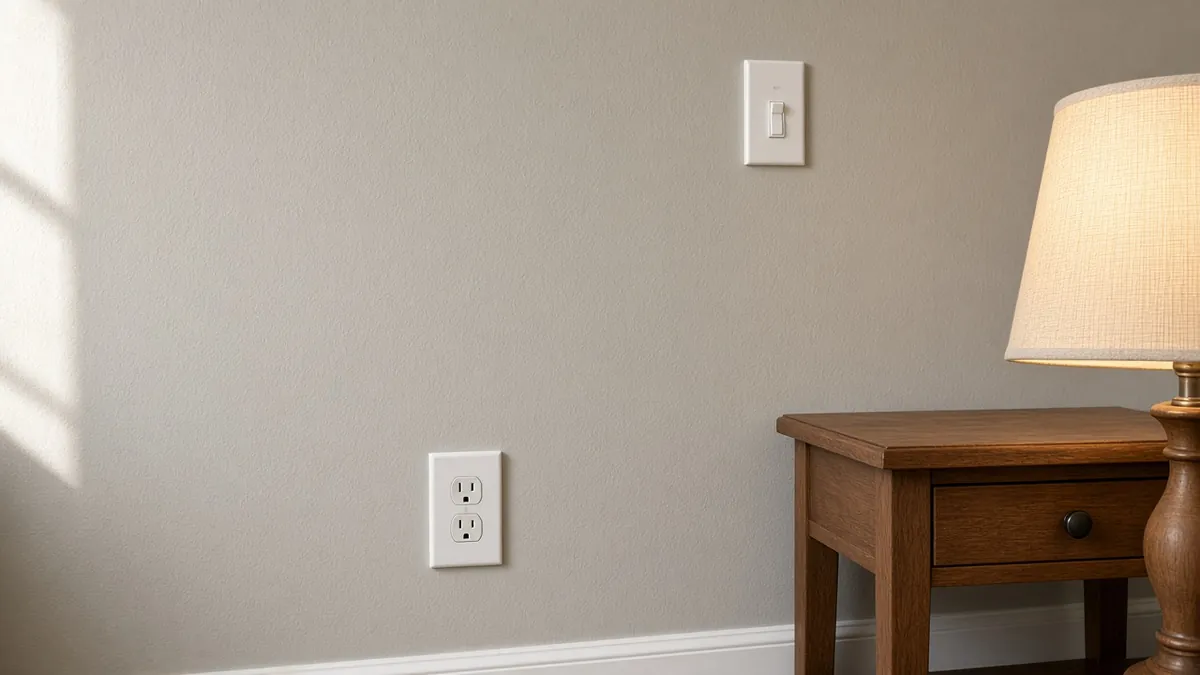
What a Half-Hot Outlet Does (and Where Code Allows It)
In a lot of American living rooms and bedrooms built without an overhead ceiling fixture, one wall switch beside the door flips on a floor lamp or bedside lamp across the room. That outlet is a half-hot (or split-switched) receptacle. Plug your lamp into the switched half and your phone charger or TV into the always-on half.
Under NEC 210.70(A)(1) Exception No. 1, a wall-switch-controlled receptacle is allowed to stand in for the required wall-switch lighting outlet in habitable rooms like living rooms, dens, and bedrooms. Kitchens and bathrooms are excluded from that exception and still require a real switched light fixture. And keep in mind that NEC 210.52 treats the required receptacle spacing along walls separately, so verify locally if an inspector counts the always-hot half toward your 6-foot and 12-foot wall spacing.
Which Break-Off Tab to Snap (and Which One to Keep)
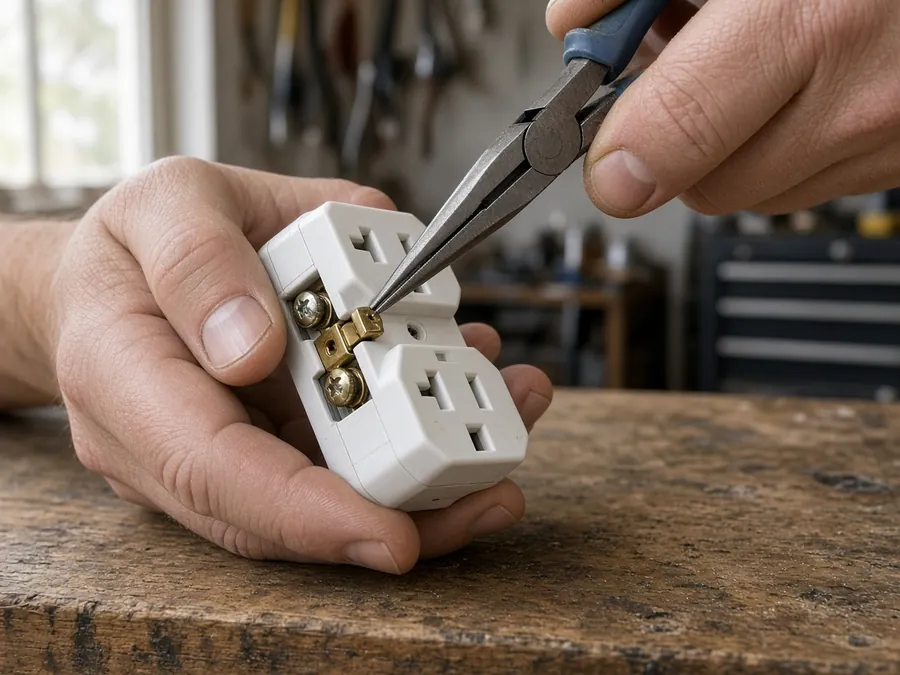
Look at the sides of a standard duplex receptacle and you'll see a narrow metal fin connecting the top and bottom screw terminals on each side. That little fin is what ties the two halves together.
| Receptacle Side | Tab Status (Single Circuit) | Wire Attached | What Happens If You Get It Wrong |
|---|---|---|---|
| Brass screws (Hot side) | Break off completely | Black (always hot) on one screw; red (switched hot) on the other | If left intact, the switch stays bypassed or shorts if on separate phases |
| Silver screws (Neutral side) | Leave intact | White neutral wire on one silver screw (shared by both halves) | If broken, the half without a neutral wire goes completely dead |
| Green screw (Ground) | No tab | Bare copper ground pigtail | Frame remains ungrounded |
Grip the brass tab with needle-nose pliers and bend it back and forth until it snaps clean at the base. Check that no sharp brass burr sticks out past the plastic body. Never break the silver neutral tab when both halves share one circuit and one neutral wire, because breaking it cuts off the return path to one plug.
Wiring Diagram: Power Enters the Switch Box First
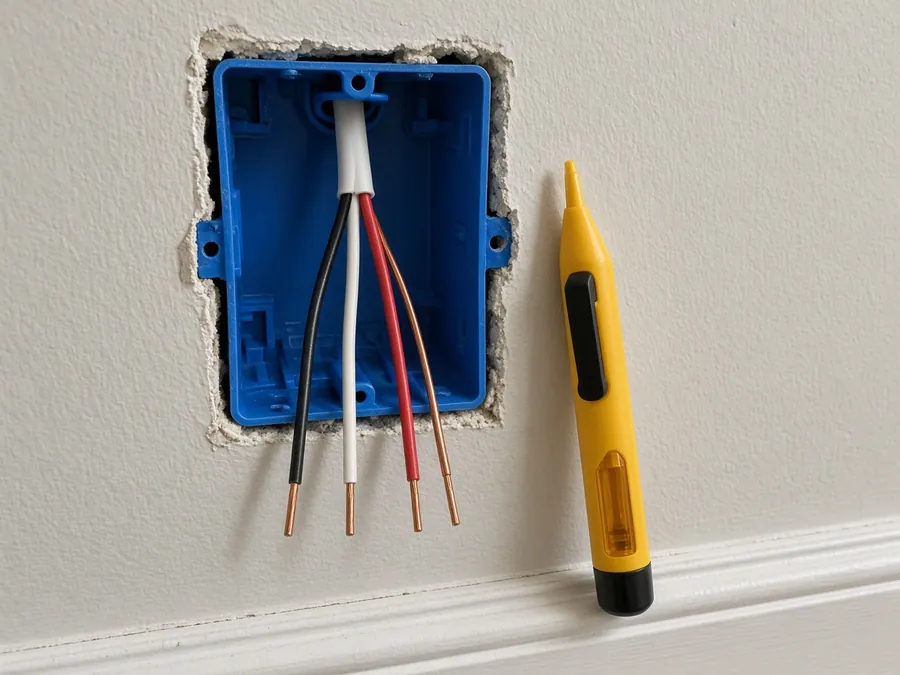
This is the cleanest modern layout because NEC 404.2(C) requires a neutral wire inside most residential switch boxes for smart switches and dimmers. Run 14/3 NM-B (for a 15-amp circuit) or 12/3 NM-B (for a 20-amp circuit) from the switch box to the receptacle box.
- At the switch box: Splice the incoming white neutral straight through to the 14/3 white wire with a wire nut, and tuck it neatly into the back of the box (no connection to a plain toggle switch). Tie the incoming black hot wire together with a pigtail to one brass switch terminal AND the 14/3 black wire going out to the outlet. Connect the 14/3 red wire to the other brass screw on the switch. Splice all bare copper grounds with a pigtail to the switch's green ground screw.
- At the receptacle box: Connect the white neutral wire to either silver screw. Connect the always-hot black wire to the bottom brass screw (or top, whichever half you prefer always hot) and connect the switched red wire to the remaining brass screw. Connect the bare ground to the green screw.
If your circuit continues from that receptacle box onward to other room outlets, pigtail the continuing black and white wires off the always-hot black and the white neutral inside the box. Do not land a downstream black feed on the switched brass screw, or half your bedroom wall will go dark every time you turn off the lamp.
What If Power Enters the Outlet Box Instead?
Older houses often bring the 14/2 power feed into the outlet box first and send a cable up to the wall switch. If you only see a 2-wire cable going up to the switch, there isn't enough conductors to keep a neutral in the switch box and carry both an always-hot and switched-hot back down without replacing the cable.
Pulling a new 14/3 cable up to the switch solves it cleanly. At the outlet box, send the constant black hot up on black, tie the incoming neutral to white so a capped neutral sits ready in the switch box per NEC 404.2(C), and return the switched power from the switch down on the red wire to the switched brass screw. If you ever convert an older switch loop, remember that under NEC 200.7(C) a white conductor repurposed as an ungrounded hot on an old 2-wire switch loop has to be permanently re-identified with black or red electrical tape at both ends—and modern code generally prohibits new 2-wire switch loops without a neutral in habitable rooms anyway.
Two Traps: GFCIs and Two-Circuit Split Outlets
Homeowners frequently ask if they can swap a half-hot bedroom or living room outlet for a GFCI receptacle. You can't split a duplex GFCI outlet into half-hot and half-switched because both plug faces sit behind one internal sensing board with no break-off tab between them. If a split outlet sits somewhere that needs GFCI protection (like near a wet bar sink), protect the entire branch circuit from a GFCI breaker at the panel or put the GFCI protection upstream in a separate dead-front or switch-box layout.
One last thing to watch in older kitchens or workshops: sometimes two halves of an outlet are split across two separate 15A or 20A circuits sharing one neutral (a multi-wire branch circuit). In that setup the two breakers must have a listed handle tie or a 2-pole common-trip breaker under NEC 210.4(B) and 210.7 so shutting off one half kills the whole yoke before you touch it.
Frequently Asked Questions
Which tab do you break for a half-hot outlet?
Break only the brass tab between the two brass screws on the hot side of the receptacle. Leave the silver tab on the neutral side intact so both halves share the white neutral return wire.
Why is the other half of my switched outlet completely dead?
The most common mistake is snapping off the silver neutral tab by accident when only one white neutral wire is connected. Without that bridge, the second half has no return path. Replace the receptacle and break only the brass hot tab.
Can I make a GFCI outlet half-hot?
No. Duplex GFCI receptacles do not have break-off tabs between their upper and lower outlets. Both faces share internal GFCI electronics, so use a GFCI circuit breaker at the panel if a half-hot outlet needs GFCI protection.
Which half of a half-hot outlet is usually switched, top or bottom?
The NEC does not require top or bottom. Many electricians wire the top half as switched so a lamp plug clearly signals which half is controlled, or the bottom half so a plugged-in table lamp hangs naturally, but either is code-compliant.
- NFPA 70 (National Electrical Code) 2023 — Sections 210.4(B), 210.7, 210.52, 210.70(A)(1) Exception No. 1, 200.7(C), and 404.2(C)
- Leviton & Eaton Residential Duplex Receptacle Break-Off Fin Installation Instructions