Double-Tap Breaker: Why Inspectors Flag It, Exceptions, and How to Fix It
Why Double-Tapped Breakers Show Up on Every Home Inspection
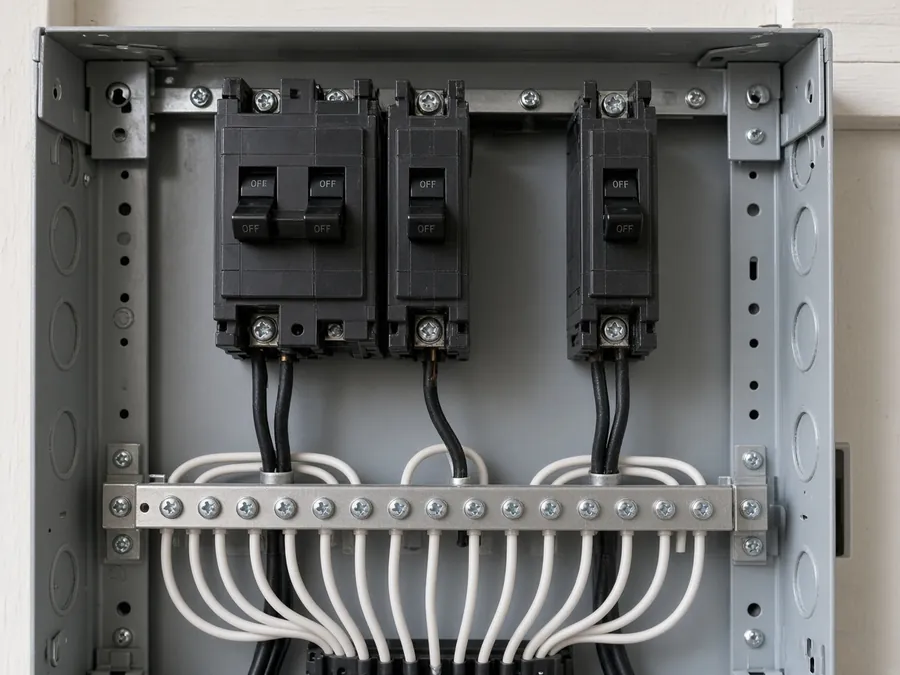
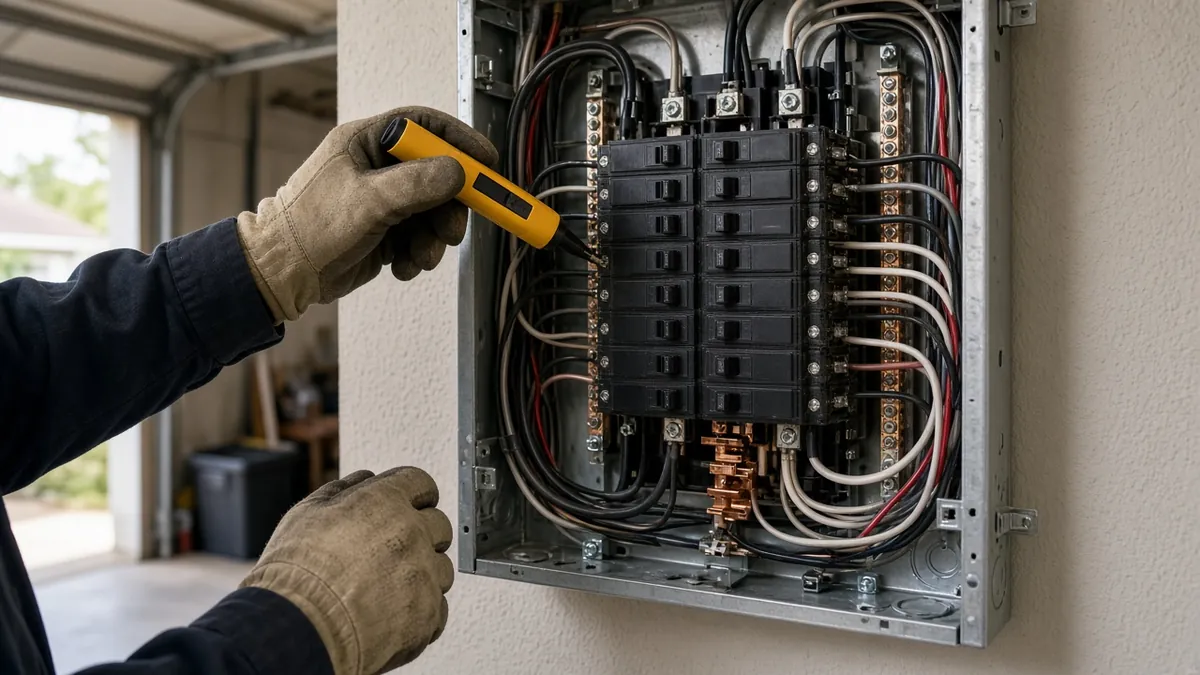
Home inspectors catch double-tapped breakers constantly, usually in panels that ran out of open slots years ago when someone added a garage circuit, patio outlet, or basement light. Instead of making space properly, the installer shoved a second black wire under an existing 15-amp or 20-amp breaker screw.
The danger isn't always that the circuit will instantly overload. The bigger issue is mechanical clamping. Most standard breaker lugs are built with one curved saddle or single set screw shaped around one round wire. Stick two wires under that screw and one wire can take the clamping pressure while the second wire sits slightly loose. Over months of heating and cooling under load, that loose wire builds resistance, arcs, and chars the breaker terminal.
What the NEC Actually Says (110.14(A) and 408.41)
Two separate code rules show up on inspection reports, and people mix them up constantly:
- Breaker terminals (NEC 110.14(A) & 110.3(B)): Equipment terminals must only hold the number of conductors they are identified and listed for. You cannot judge by whether two wires physically fit under the screw; the breaker label or catalog sheet has to permit two conductors.
- Neutral bus bars (NEC 408.41): Each white grounded neutral wire in a panelboard must terminate under its own individual screw. Two neutrals under one neutral-bar lug is virtually always a code violation, even if the bar looks spacious.
- Equipment ground bars: Grounding bars are different. Most residential panel wiring diagrams explicitly list how many bare copper ground wires of the same gauge can share a single screw (often two or three #14 or #12 grounds, though never mixed with neutrals).
Which Breakers Actually Allow Two Wires
Not every double tap is illegal. Before you pay to rearrange your panel, read the text printed right on the side or face of the breaker (with the panel cover off, power off or keeping hands well clear of energized lugs).
| Breaker Line | Two-Wire Terminal Listing | What to Look For on the Breaker |
|---|---|---|
| Square D Homeline (HOM) | Yes, on most 15A–30A single-pole models | Pressure-plate lug marked for 2 conductors (e.g., 2-#14 to 2-#10 Cu/Al, same wire gauge) |
| Square D QO | Select models only (especially 15A–30A older/standard styles) | Recessed dual grooves under a square pressure plate and "2 cables" rating on label; check exact model |
| Siemens (QP / QT) | No (1 wire only) | Single-wire lug marking; tandem/twin breakers used instead for extra circuits |
| Eaton / Cutler-Hammer BR & CH | No (1 wire only) | Marked for 1 conductor per terminal; double taps fail inspection |
| GE (THQL / THQP) | No (1 wire only) | Single conductor per terminal screw |
Even on a Square D breaker rated for two conductors, manufacturer rules still apply: both wires generally must be the same size and same metal (two #12 copper wires, for example, not a #12 paired with a #14 on a 20-amp breaker). And of course, you still can't put #14 wire on a 20-amp breaker under NEC 240.4(D).
Three Ways to Fix an Illegal Double Tap
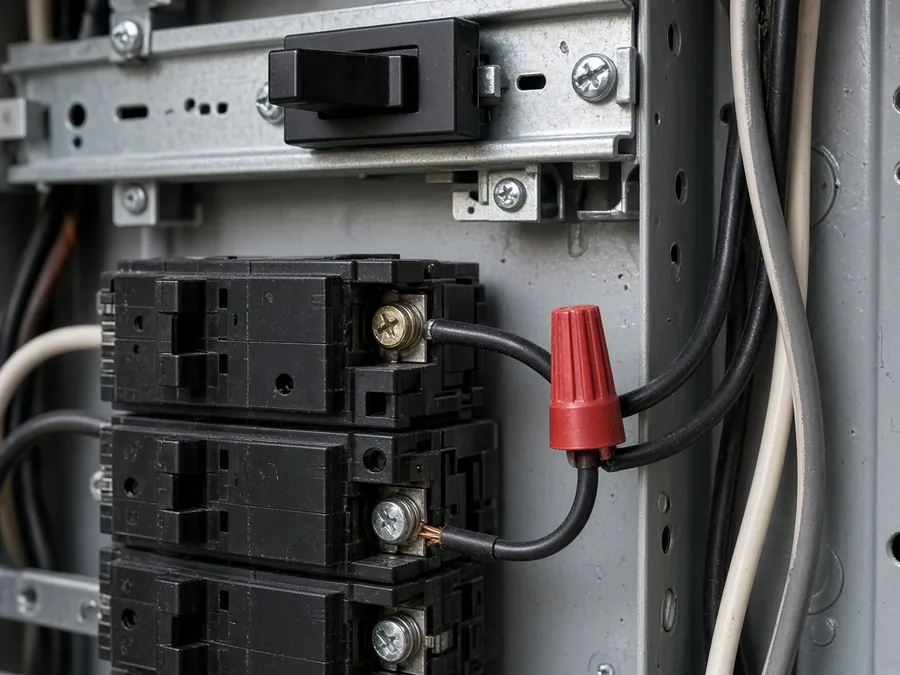
Once you verify your breaker only allows one wire, fixing it is straightforward for an electrician or confident homeowner who knows how to safely isolate power:
- Pigtail the two wires inside the panel: This is the fastest fix when combined loads on both wires belong safely on that one 15A or 20A circuit. Turn off the main breaker (remember the main service lugs above it stay live!), remove both black wires from the breaker screw, splice them together with a short 6-inch matching-gauge black pigtail using a listed wire nut or lever connector, and land that single pigtail under the breaker screw. Splicing inside a panel enclosure is explicitly permitted under NEC 312.8 when gutter space isn't overfilled.
- Add a new full-size or tandem breaker: If the two wires feed heavy areas like a kitchen and a garage that really ought to stay separate circuits, move one wire onto an empty breaker space. If the panel is full, check the panel directory sticker to see if your specific load center slots are rated for tandem (twin) breakers.
- Install a subpanel: When every permitted slot is full and loads are high, a subpanel opens up clean new breaker spaces rather than cramming wires together.
While you're inside the panel, scan the white neutral bar too. If you spot two white wires stuffed under one neutral screw, move one to an open hole on the neutral bar—never pigtail a neutral to hide a double lug if there are empty holes available, though splicing inside the panel is allowed when truly needed under NEC 312.8.
Frequently Asked Questions
Are Square D breakers allowed to be double-tapped?
Many Square D Homeline and certain QO 15A–30A breakers have pressure-plate terminals listed for two conductors of the same size and material. Always check the printed label on the specific breaker rather than assuming every Square D breaker is dual-rated.
Is it legal to pigtail wires inside a breaker panel?
Yes. NEC 312.8 allows splices and taps inside panelboard wiring spaces as long as the conductors, splices, and taps do not exceed 75 percent of the cross-sectional area of the space.
Can two white neutral wires share one screw on the neutral bar?
No. NEC 408.41 requires every grounded neutral conductor to terminate in its own individual terminal on the neutral bar so disconnecting one circuit never interrupts another circuit's neutral return.
Is a double-tapped breaker a fire hazard?
It can become one if the terminal is rated for only one wire. Two wires under a single-wire set screw can loosen over thermal cycles, creating high-resistance arcing and heat inside the breaker.
- NFPA 70 (National Electrical Code) 2023 — Sections 110.3(B), 110.14(A), 240.4(D), 312.8, and 408.41
- Schneider Electric Square D Homeline & QO Load Center Terminal Wire Capacity Data Bulletins
- Eaton BR / CH and Siemens QP Circuit Breaker Installation Instructions