How Many Outlets Can You Put on a 15-Amp or 20-Amp Circuit? (NEC Rules)
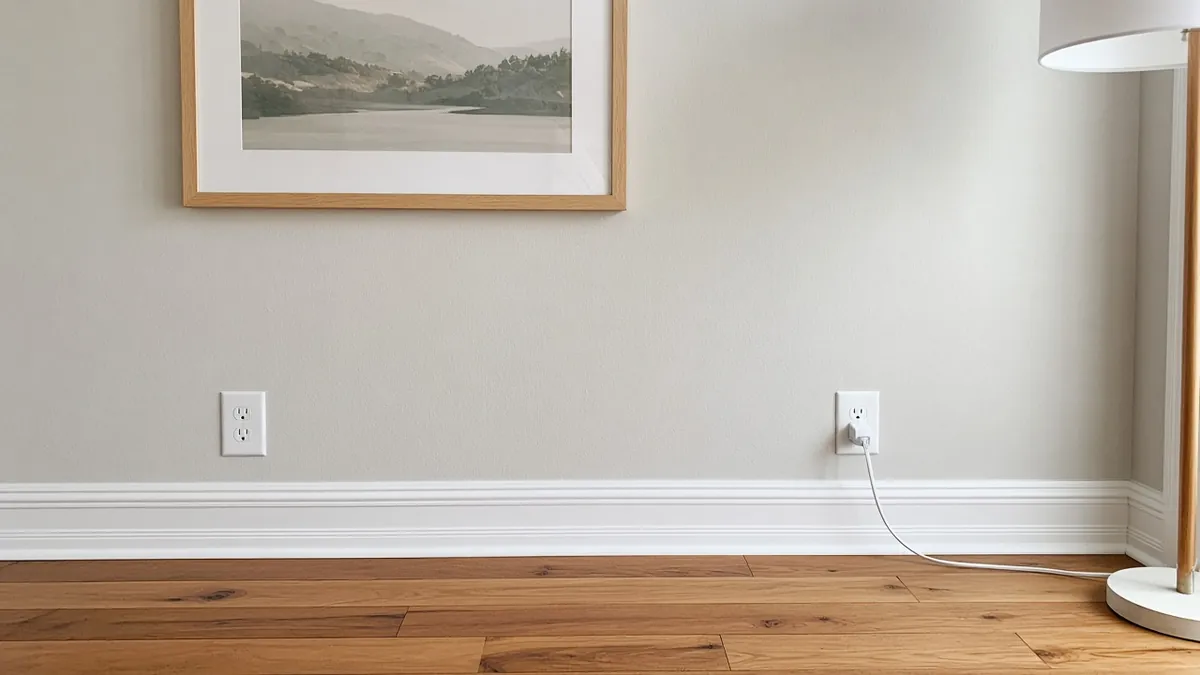
Why the NEC Has No Residential Outlet Count Limit
Ask three electricians how many wall outlets fit on a 20-amp circuit and you'll probably hear "13" or "10," or maybe "8 if you want headroom." Yet open the NEC codebook looking for a residential max-outlet table and you won't find one.
Under NEC 220.14(J) (moved to Section 220.41 in the 2023 NEC), general-use receptacle outlets rated 20 amps or less in one-family, two-family, and multifamily dwellings are folded straight into the 3 volt-amps per square foot general lighting load calculation. Adding another duplex wall plug in a living room doesn't add extra wattage to the home—it mostly just gives your floor lamp or vacuum cleaner a closer spot to plug in without stretching an extension cord.
And the NEC focuses on what actually trips breakers: what you plug in at the same time, and which rooms hold heavy heating or motor appliances.
Where "10 on 15A" and "13 on 20A" Come From
Those exact numbers aren't made up—they come from commercial and non-dwelling occupancies under NEC 220.14(I), where each single or duplex receptacle strap (yoke) is calculated at 180 volt-amperes (VA):
| Circuit Size (120V) | Total Circuit Capacity | 80% Continuous Target | Non-Dwelling 180 VA Rule (NEC 220.14(I)) | Practical Home Rule of Thumb |
|---|---|---|---|---|
| 15-Amp (14 AWG wire) | 1,800 VA (1,800 W) | 12 A (1,440 W) | 10 yokes (1,800 ÷ 180 = 10) | 8–10 outlets in light-load rooms |
| 20-Amp (12 AWG wire) | 2,400 VA (2,400 W) | 16 A (1,920 W) | 13 yokes (2,400 ÷ 180 = 13.3) | 10–12 outlets in general rooms; far fewer in workshops |
Notice one detail that surprises DIYers: a duplex outlet with two plug slots counts as one yoke (180 VA in commercial math), not two. Also check with your local city or county building department before pulling wire—a handful of local municipalities adopt their own amendments putting a hard 8- to 12-outlet limit into residential inspections even though the national model code doesn't.
The Real Code Limits That Restrict Your Circuit
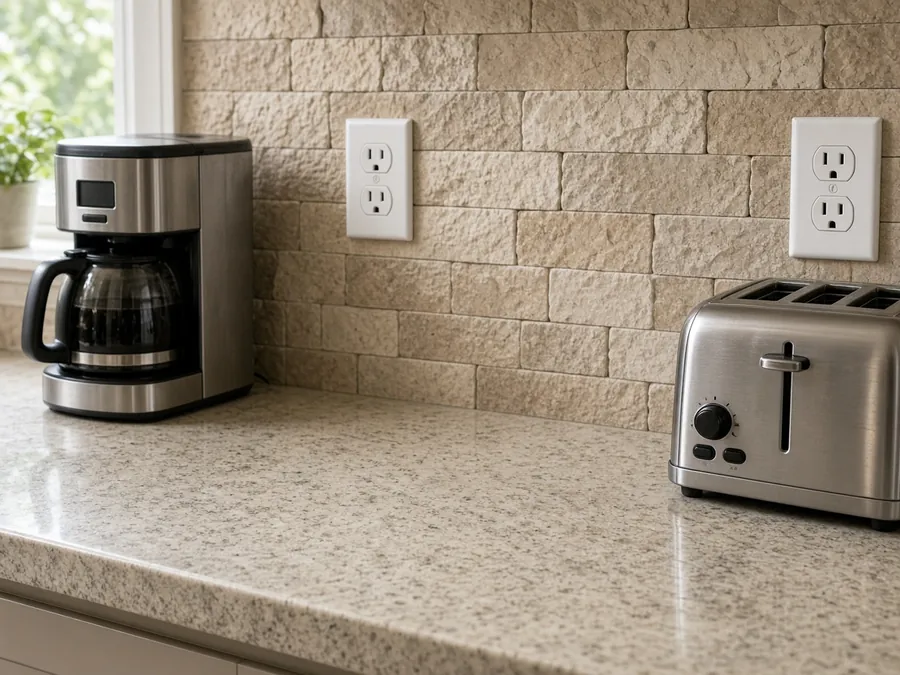
Even without a residential outlet count cap, several hard NEC rules control what goes where:
- The 80% single-appliance limit (NEC 210.23(A)(1)): On any 15A or 20A circuit serving two or more outlets, no single portable cord-and-plug appliance may draw more than 80% of the circuit rating (12 amps on a 15A circuit, 16 amps on a 20A circuit).
- The 50% fastened-in-place limit (NEC 210.23(A)(2)): If an appliance fastened in place—like an under-cabinet microwave or wall heater—shares a general circuit with other outlets, it cannot exceed 50% of the circuit rating (7.5A on 15A, or 10A on 20A).
- Required dedicated 20-amp circuits (NEC 210.11(C)): Kitchen countertops need at least two dedicated 20-amp small-appliance circuits; laundry areas need a dedicated 20-amp circuit; bathrooms need at least one dedicated 20-amp circuit; and garages need at least one dedicated 20-amp circuit for receptacles. You cannot borrow bedroom circuits for these spaces.
- Receptacle spacing rules (NEC 210.52): Every habitable room wall 2 feet or wider must be placed so no point along the floor line is more than 6 feet from an outlet (roughly every 12 feet).
Practical Load Planning by Room
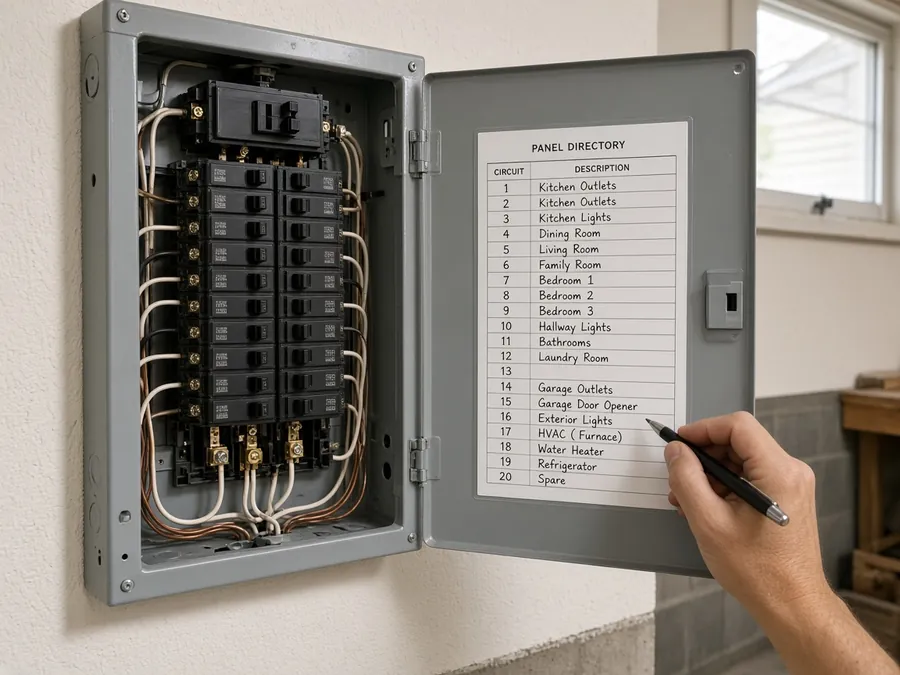
Counting outlets matters far less than estimating simultaneous watts. A 15-amp bedroom circuit with 10 outlets powering phone chargers, two bedside lamps, and an alarm clock barely pulls 2 amps total. Put just two 1,500-watt space heaters on two outlets in that same room and you immediately pull 25 amps and trip the 15-amp breaker.
In kitchens, workshops, and home offices, plan around real appliances rather than outlet count. Put no more than two or three countertop outlets per 20-amp kitchen small-appliance circuit if you regularly run a toaster oven, electric kettle, and espresso machine at breakfast. In a garage workshop, keep dust collection or air compressors on a separate 20-amp circuit from your table saw so startup surges don't leave you standing in the dark.
Frequently Asked Questions
Is there an NEC maximum number of outlets on a 15-amp circuit?
No. For residential dwellings, NEC 220.14(J) (220.41 in the 2023 NEC) sets no hard outlet cap on 15-amp or 20-amp general-purpose circuits, though local city amendments sometimes enforce their own limit—usually 8 to 10 outlets.
Can I mix lights and outlets on the same 15-amp or 20-amp circuit?
Yes, for general living spaces like bedrooms, hallways, and living rooms. However, NEC 210.11(C) prohibits tying general lighting onto required 20-amp kitchen small-appliance circuits, laundry circuits, or (usually) bathroom receptacle circuits serving multiple rooms.
Can a single 15-amp outlet go on a 20-amp circuit?
Yes, if there are two or more plug positions on the circuit—including one standard duplex receptacle (which counts as two receptacles under NEC 210.21(B)(3)). Only a true single simplex receptacle alone on a dedicated 20-amp circuit must be rated 20A.
How many watts can a 20-amp circuit safely run continuously?
A 120V 20-amp circuit has 2,400 watts total capacity, and 1,920 watts (16 amps) at the 80% continuous-load limit for loads running 3 hours or longer.
- NFPA 70 (National Electrical Code) 2020 & 2023 — Sections 210.11(C), 210.21(B)(3), 210.23(A), 210.52, 220.14(I), and 220.14(J) / 220.41